









News:
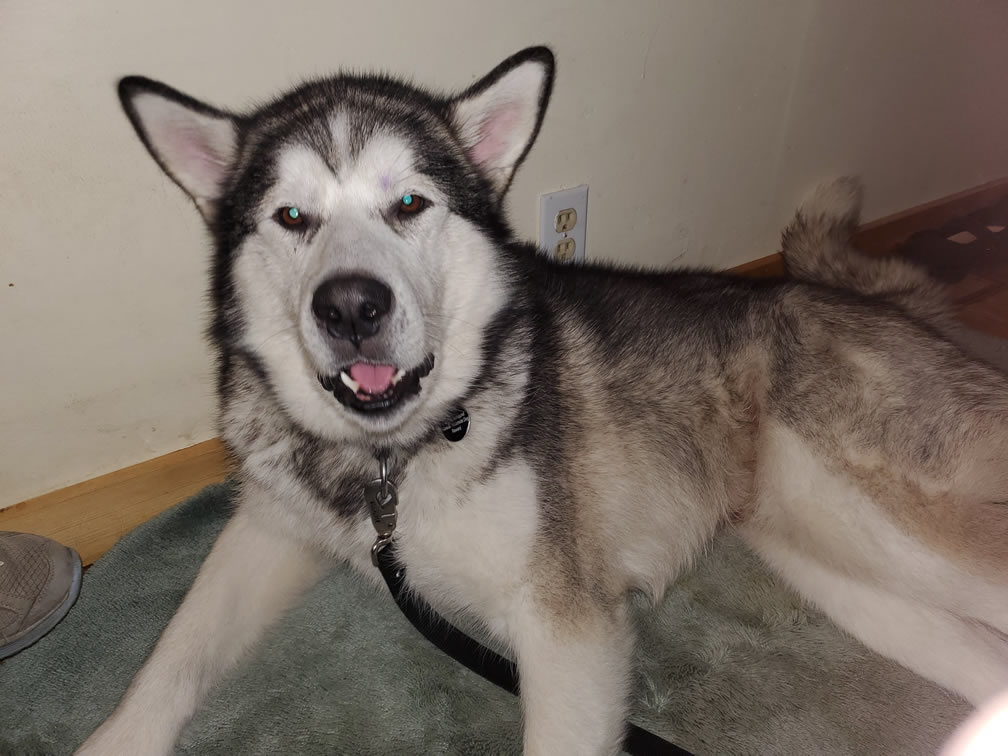
We were down to 2 O'Mal dogs (and 12 new chickens..don't ask!) We were seriously thinking of getting a rescue boy that will get along with the 2 girls. We're getting older too, so our days of lots of dogs are pretty much done....but we still love the breed. So we contacted Golden Years who works with Few Steps from Home now. Carol and Heather had two beautiful boys available and we drove down to Gladwin, Michigan to meet them. One was a good fit...we've renamed him Alvin (he just seemed like an Alvin rather than the odd name he already had) and he's now a part of our family. He's a good boy with typical young male issues that weren't addressed when he was a puppy...we love him so much! We were looking for a boy Dan could take on walks, and a playmate for LeeLou (Netiri has no interest in any other dog since Jazzy and Mocha). Dan got his walking dog...up to 5x a day! It's taking a little longer for LeeLou...he's loud, he plays rough, and he's a lot bigger than her so it's going to take time for her to trust him and for him to realize she'll be a great friend. In the meantime, we are working on his issues....full story here. We're thrilled to have found such a nice boy who fits into our home so well.
After some lovely emails, I've decide to keep this site up as long as I can for the information it holds for those that need it. Perhaps I'll even go into more aspects of rescuing. It's just getting harder to find the time to maintain this site though it has lots of information that will always be helpful if you have a malalmute or any other northern breed.
From Our Alaskan Malamute Dog Loving Family to Yours...
When we got our first Malamute, we soon discovered the lack of information on just what it's like to LIVE with one. This dog just didn't do things the way other dogs we had owned did. The best books described their heritage, their working ability, their history. Some of the books merely hinted about how different they were from other breeds, but never elaborated. Some went into great detail as to how to build escape-proof kennels with proper drainage, praised the Malamute's ability to survive in a desolate arctic wilderness in subzero temperatures, praised his strength and stamina at sledge pulling, admired his tough no-nonsense personality. The web was new then, there weren't any decent sites even about dogs, much less the hard to understand Malamute. No one told us how to incorporate her into our suburban household with little kids as a family pet.
We fell in love - far from the habitat of the great white north. We soon discovered her penchant for digging, stealing the roast and shedding bushels of hair on the furniture. Though we bought her from a breeder, he was no help since his dogs all lived in kennels, visiting in the house only occasionally. He didn't KNOW his dogs like we knew ours. When he gave advice, it didn't apply because we had a housedog. (Dogs that were kenneled were much more obedient and rarely "sassed back", since they are so grateful for any attention. No so with a "spoiled" housepet).
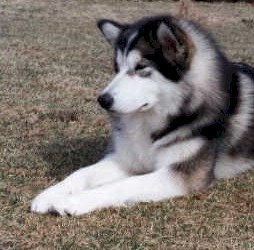
We approached other breeders and owners and
soon discovered many "housedogs" are only part-timers
- rotated in and out of kennels visiting in the house. Puppies raised
"in the house" were usually kept in a basement or back room, away
from everyday household noises.
Through trial, error and volumes of reading we learned to live with our girl, completely unprepared for her depth of personality and persistence, and finally came to appreciate her magnificent abilities and what a great housepet she'd become with a little effort. Of course, once you love one Malamute, sometimes it's only a matter of time before one isn't enough!
In our quest for a quality show dog we decided to become breeders ourselves, vowing to do things differently. All our dogs live in the house with us, ALL THE TIME. Nobody is kenneled. We came to find where there was depth in one Malamute, there is the depth as expansive as the wilderness in several when they all live in the house with you. Wolves have nothing on a Malamute pack. A Malamute pack is just as loving, just as playful, just as serious about pack order and just as devoted to one another - and challenging to live with!
So with this in mind, we are sharing our experiences with you on this website and have been going on 19 years now. We were one of the first sites to give out breed specific information. While everyone else ignored woolies, we made a page about them. While everyone else elaborated about show brags - we wrote pages and pages about what it was like to live with them - IN the house. (Other breeders were telling puppy buyers they could never be good house pets). We never want you to have to banish a destructive brat to a makeshift prison in the back yard sadly apart from his loved ones if you can learn from others mistakes - the sad fate of too many cute Malamute puppies. This is in many ways dedicated to all the rescue Malamutes that tried hard to be housedogs, but were given up or banished to an outdoor pen for being "a pain" in the house, only because their frustrated owners couldn't figure out how to fit a primitive dog into modern society.
This is why we love Malamutes. But, why such a big website for such a small hobby breeder that no longer breeds? Because it's a labor of love! It started out as just a few pages way back in 1998 and just grew with our experiences! I also want you to be more prepared than I was (having only owned small dogs) so started writing about our experiences with our dogs. Apparently our experiences have turned out to be quite universal among Malamute owners.
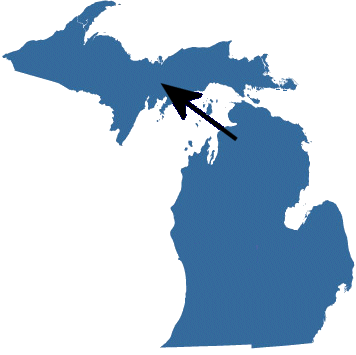
Though we are no longer breeding, we have finally attained a lifelong dream to move up north to really enjoy the dogs and all that a northern Michigan winter has to offer. We live in Northern Michigan's Upper Peninsula - right smack in the middle...not far from Pictured Rocks, Marquette, Escanaba, federal & state forests, and 20+ beautiful waterfalls.... It has been wonderful to have 40+ wooded acres to take long walks with the dogs and enjoy the abundant snow. Stay tuned...I still have a few articles in my head and pages to add...I'm not even close to done yet!
The Alaskan Malamute .... 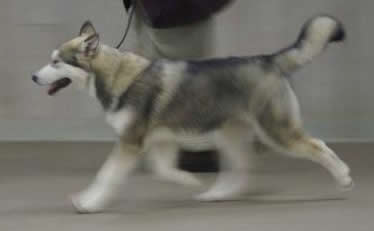
No breed is as loyal, intelligent or beautiful than the strong, " Alaskan Malamute ". Bred to survive, and used for pulling in the cold arctic, Malamutes have adapted to being housedog companions to adults and families having children in modern times. An Alaskan Malamute will become your best buddy, and while they care for their family, they are rarely protective except of children. Friendly, charming and playful - Malamutes love people. Quiet house Malamutes, Malamutes do need regular exercise and a job such as pulling sleds, walks, biking, skijoring, weight pulling, carting, running, sledding and keeping busy. Malamute double thick fur ranges in color from red, gray, silver, black to all white. Open face, mask and cap are typical markings that distinguish the breed. Our Alaskan Malamutes tend to be sables and gray & whites with mostly open faces (sometimes there is a bit of eyeshadow under the eyes like a football player or mascara that ran).
In winter, though they love being outdoors, Malamutes prefer being indoors to be near the family pack. Alaskan Malamutes are part of the working group, and are often confused with the "alaskan husky", "Siberian Husky", Samoyed, "Greenland Eskimo" dog, "wolf dogs" and wolf-hybrids. Purebred Alaskan Malamutes registered by the AKC, CKC and UKC come in Maloot, Kotzebue and Hinman strains, named after regions in Alaska where first discovered. Currently there are several lines of Malamutes; ours include Storm Kloud, Hill Frost, Sno Ridge and Glacier predominantly. We recently outcrossed and brought in Ice Cream lines, which include a tiny amount of Sno Klassic and Nanuke to our lines.
Alaskan Malamutes are large, but not a giant breed, because smaller was a better use of resources. Alaskan Malamutes became sturdy, strong and durable - able to survive arctic winters. A giant Alaskan Malamute or what is often called a Mackenzie River Husky has less stamina to survive and would require larger quantities of food than an ordinary Inuit family could provide. There are also wooly malamutes - where the coat is longer and thicker. The AKC standards says the correct size is from 60 to 75 pounds for females and 70 to 95 pounds for males, which is what we breed. A profile of the breed, health information, grooming, history, temperament, about breeders, hints, psychology, and miscellaneous information on housepet Malamutes, dog shows, and puppies are here at O'Mal Alaskan Malamutes website. Note I said house Malamute Malamutes, since that's what we have - no kennel dogs here! Yes, it gets pretty crazy having them all in the house!
 Sadly, many of these beautiful arctic canines
get abandoned at shelters or rescued by purebred rescue organizations every
year. Malamutes tend to be very pack oriented, unlike most other breeds. Pushy
and dominant - the Alaskan Malamute is difficult for some people to live with.
Shelters prefer to adopt most northern breeds to homes having fenced yards - Alaskan Malamutes won't
stay on unfenced property - roaming, hunting small animals and deer.
Sadly, many of these beautiful arctic canines
get abandoned at shelters or rescued by purebred rescue organizations every
year. Malamutes tend to be very pack oriented, unlike most other breeds. Pushy
and dominant - the Alaskan Malamute is difficult for some people to live with.
Shelters prefer to adopt most northern breeds to homes having fenced yards - Alaskan Malamutes won't
stay on unfenced property - roaming, hunting small animals and deer.
The AMCA or "Alaskan Malamute Club of America" educates puppy buyers on the breed temperament and unique characteristics of the arctic sled dog. Members of the AMCA since 1989, we aspire to be reputable breeders that abide by the club's code of ethics, and consider ourselves hobby breeders, though we are no longer breeding.. We live in Trenary, Michigan and my web site contains stories, pictures and general information regarding Malamutes as well as general characteristics of the breed.
We used to breed AKC registered puppies available to Malamute homes and sometimes to show. Did you know an incorrect long coat is called a wooly coat? It looks similar to the fur on a Collie. Groomed it is beautiful to look at, but may pose quite a chore due to matting and may require a professional groomer's assistance. Most breeders sell Alaskan Malamute woolies as Malamutes (or should!) and typically woolies aren't shown since the wooly long coated Alaskan Malamute is incorrect, albeit beautiful.
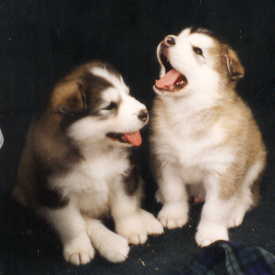 Malamutes originated in Malmut Sound Alaska and were bred
by the Inuit people of northern Alaska. A native American breed, Alaskan Malamutes have been recognized
by the national breed clubs and AKC, CKC, UKC as strong, intelligent and dominant
requiring exercise and a fenced yard. The Malamute was recently named the official state dog of Alaska! Alaskan Malamute puppies may be cute,
but Malamute rescues and humane society organizations get them too often as Alaskan
Malamutes tend to howl, dig, challenge authority, and be quite mischievous.
Sled dogs are capable at showing, working, and pulling but can be difficult to
train in obedience or agility. They were bred to pull heavy loads over long distances in the arctic for Inuit families until the turn of the century when snow machines became the preferred mode of transportation.
Malamutes originated in Malmut Sound Alaska and were bred
by the Inuit people of northern Alaska. A native American breed, Alaskan Malamutes have been recognized
by the national breed clubs and AKC, CKC, UKC as strong, intelligent and dominant
requiring exercise and a fenced yard. The Malamute was recently named the official state dog of Alaska! Alaskan Malamute puppies may be cute,
but Malamute rescues and humane society organizations get them too often as Alaskan
Malamutes tend to howl, dig, challenge authority, and be quite mischievous.
Sled dogs are capable at showing, working, and pulling but can be difficult to
train in obedience or agility. They were bred to pull heavy loads over long distances in the arctic for Inuit families until the turn of the century when snow machines became the preferred mode of transportation.
While an Alaskan Malamute may be comfortable in cold arctic winters in Northern Alaska, he can make a wonderful housepet too. Alaskan Malamute fur sheds and will "blow" during the warmer months, so they can be comfortable indoors year-round. They have beautiful double coats, and require regular grooming. Proper care of an Alaskan Malamute's coat allows best comfort in warmer climates as house Malamutes. Breeders of quality Malamute companions of excellent temperaments, we hope to produce purebred Alaskan Malamutes that enjoy conformation, obedience, agility and most of all, be wonderful family Malamutes. We don't use kennels, our dogs live inside our house and love children. O'Mal's goal is to improve every aspect of genetic health and temperament of the Malamute as he fits into modern society long into old age.
Our dogs are our pets, show dogs, and family and live in the house with us. Please enjoy your visit and meet our pack. We offer a wealth of information about what the breed is REALLY like. We don't gloss over the details and want you to understand the tumultuous ride you're in for if you're a first time Alaskan Malamute owner - BEFORE you buy a puppy somewhere and it ends up in a shelter or rescue! We are celebrating our 19th anniversary online - we are probably one of the longest running personal websites about the Alaskan Malamute. If you discover any problems with anything, or would just like to say hello, I'd love to . When we did breed, we practiced accepted methods of linebreeding to ensure the health and temperament of every puppy. Thanks for your long time support and interest in our family website. I just love when you call years after a first contact just to let us know how you're doing.
Want to know more about Alaskan Malamutes and what it's like to live with them? Start here....
This website is supported personally by Cindy and Dan of O'Mal Alaskan Malamutes. Omalmalamutes.com is a participant in various affiliate programs designed to provide products and services for a commission. We thank you for your purchases through the links on this site, as it helps us defray the costs of keeping this information online.
Thanks for visiting