












The Golden Years 
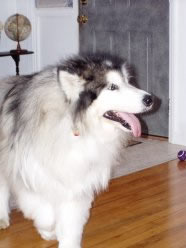
Malamutes are graceful agers. Though the muzzle gets gray and the coat looks a little shaggier, a dignity is always there. Typically a Malamute becomes middle aged around 5 or 6 and a senior by 8 or 9. A typical life span for Malamutes is between 10 - 14 years and is very dependent on lines and lifestyle. Whereas a kennel dog may age faster due to weather exposure and even hard work, a house dog will age slower - provided you keep him in good health and not overweight. Many Mals are robust and hopeless comedians until old age - I know people who are still asking at 10 years - "Hey, where is this supposed dignity on maturity supposed to happen - I'm still waiting!"
With aging comes a slower metabolism, and in Malamutes this can often mean weight gain since their metabolism tends to be slow anyway. Keep track of your dog's weight and if he is 5-10 lbs over what he should be, put him on a diet. A fat dog is not a healthy dog - and it's easy because you see him every day to ignore small weight gains until the dog is hugely obese. Don't. A fat dog is at risk for heart disease, diabetes and more. A thyroid profile should be included in any general blood work done by your vet for an older dog. Thyroid disease is quite common in Malamutes so it's not unusual to test and discover a "low normal" range for an otherwise healthy dog as he ages. A dry looking coat can also be a sign of thyroid disease or other problem - have it checked out. Sometimes minor supplementation can bring back some of the spunk you remember as a youngster or make an older dog less "crabby".
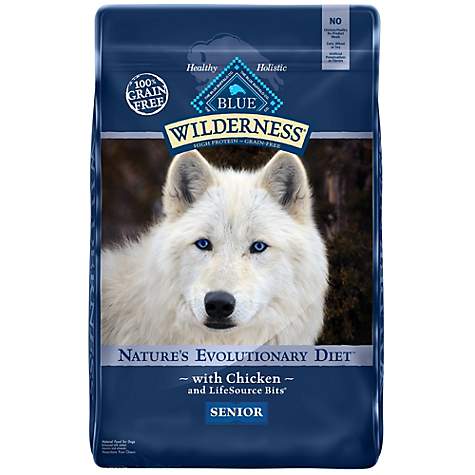
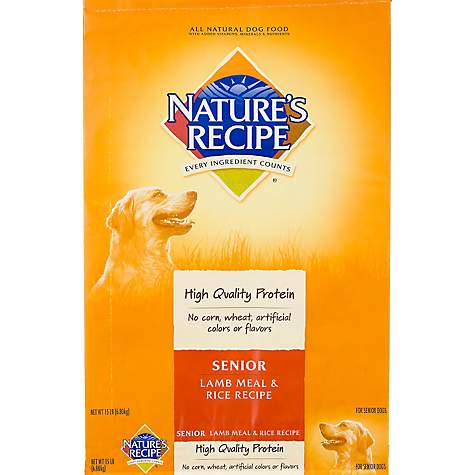
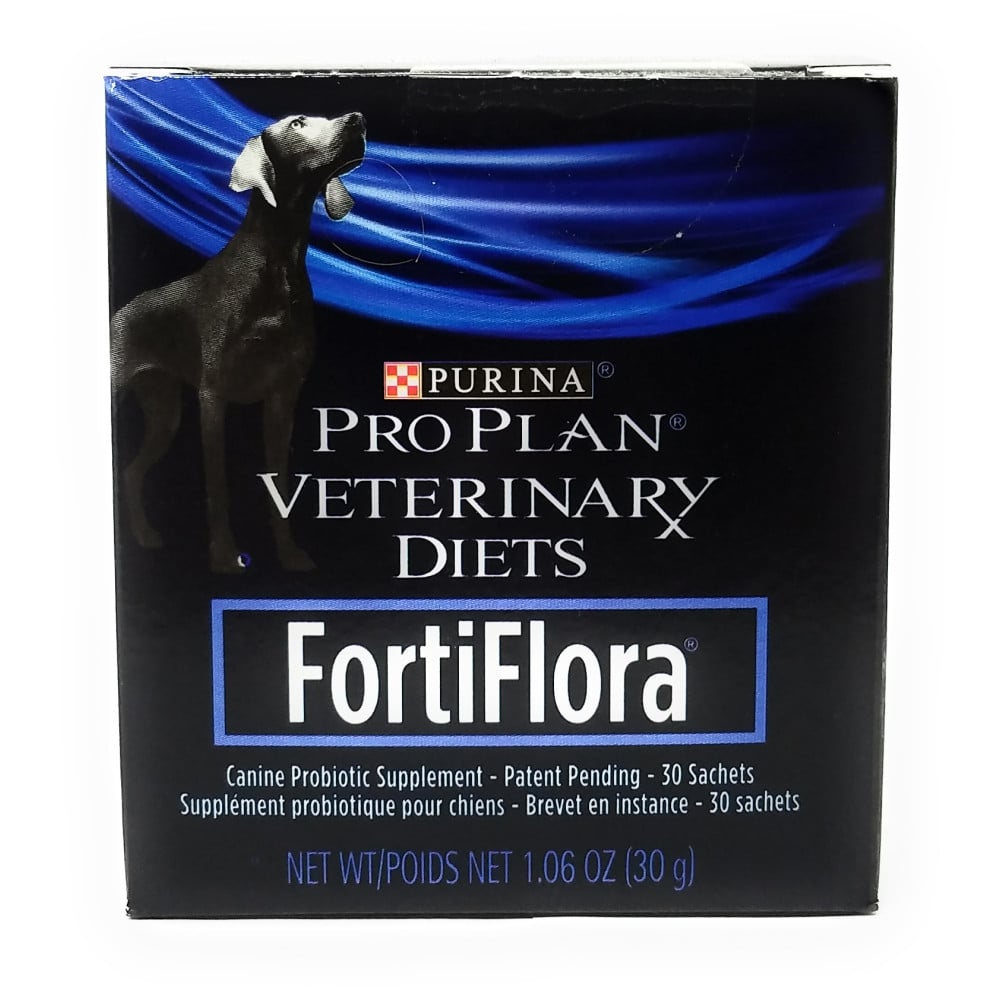
 As the golden years approach, you may want to consider changing to a "light" food if necessary. Research indicates less protein is better for kidneys and health in an older dog, however, to maintain a good coat he will still need some fat in the diet. Ours so far have done just fine on their "regular" food, we just feed a bit less. Others recommend a higher-fiber, fat- and calorie- reduced "senior" formulation (high-protein foods may help your dog maintain his lean body mass). A good supplement is something with Omega 3 and zinc. Ask your vet for suggestions - but avoid foods that get much of their protein from milk products. Although not documented, our personal experience is there are quite a few "lactose intolerant" Malamutes out there (how many dairy cows were in prehistoric Alaska?) so we feel it's better to be safe than risk diarrhea, gas or serious stomach upset in an older dog. Foods that we've found to cause problems are Innova and Science Diet, but I'm sure there are others. (Some people love these foods, this is just our experience).
With age, large chested males become more at risk with age for a serious condition called "bloat" which is a medical emergency. If your dog (male or female) begins screaming in pain, attempting to vomit and can't, the stomach feels hard to the touch - it is a grave medical emergency. You have only minutes to get him to a vet with the proper equipment to treat this high-risk condition. Call around and make sure ahead of time your vet is prepared to treat this - we know of a vet that sent a frantic owner on to Michigan State because her dog had symptoms of bloat which they were unprepared to treat. Fortunately it wasn't bloat or the dog would have died in the delay - period. Have a plan a head of time.
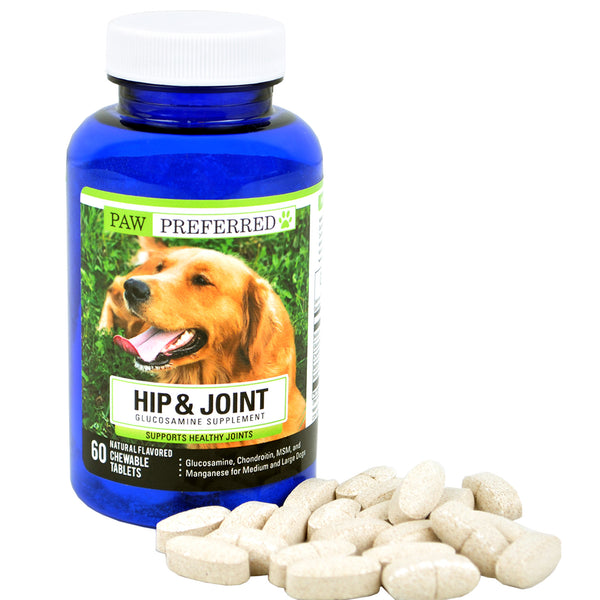
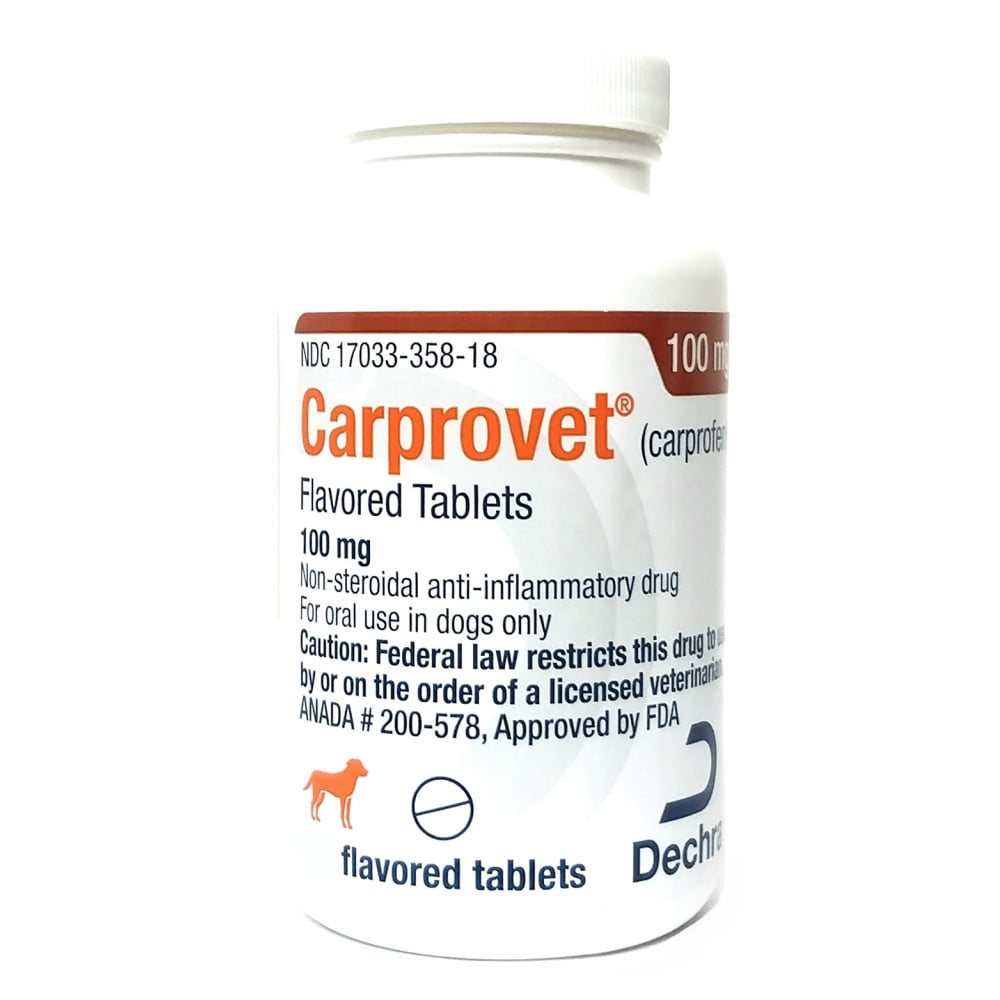
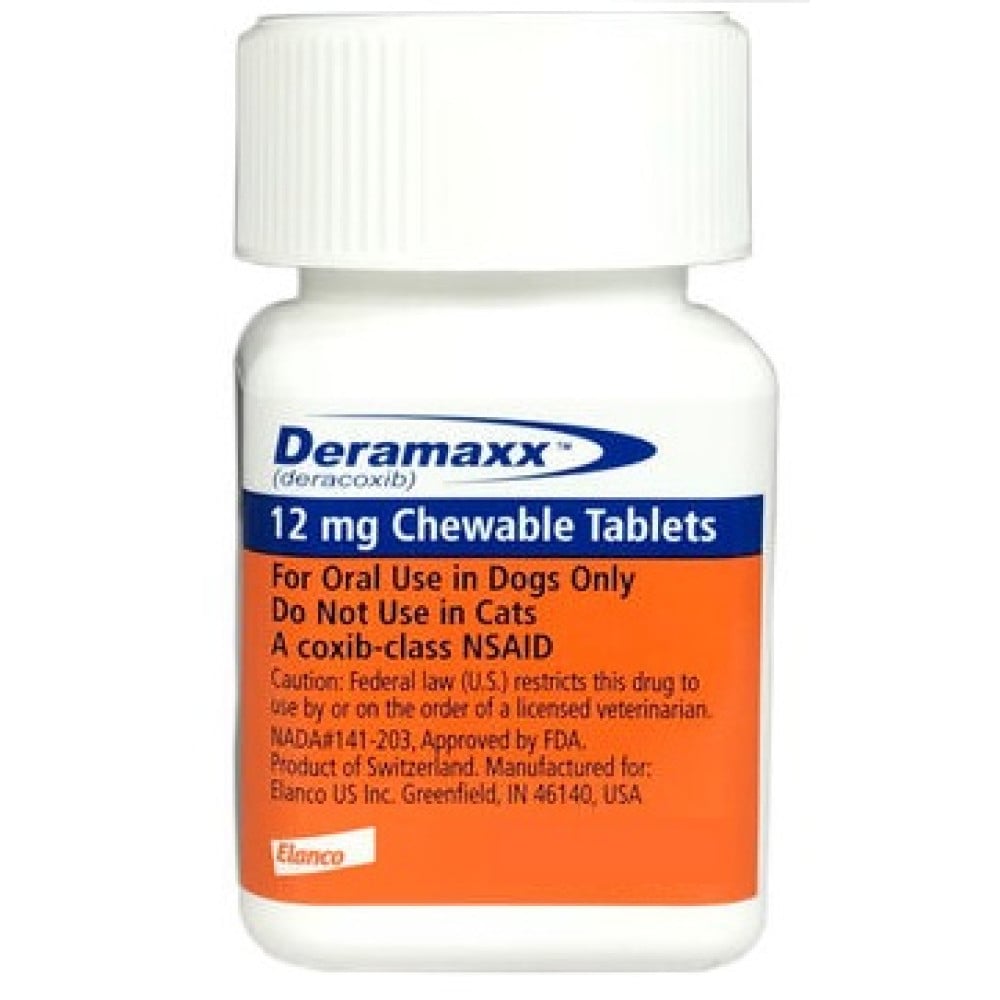
Keep an old Malamute fit! Sure, he may not feel like pulling sleds and skijoring all over anymore, but a regular walk is nice. Most Mals are content to be complete couch potatoes, but no matter how content he seems to be watching the TV, get him out and do something - his mind needs stimulation as much as his body. Slow down your pace and shorten your walks, if need be, but don't forgo activity altogether. To help your dog get his stiff, arthritic joints moving each morning, or to help ease the nagging pain of hip or elbow dysplasia, spend a few minutes gently messaging his joints. If you're short on time, you might consider focusing on his ears and feet to give him a jump-start to a pain-free day: According to practitioners of dog acupuncture and massage, the ears and feet contain all the energy paths for the entire body (although such pats are scientifically unproven). As an added bonus, when you're massaging your dog, you'll be likely to notice any lumps, bumps, and skin and coat changes, all of which should be reported to your vet. Also, some people believe in Cosequin and other products to help rebuild cartilage on arthritic joints. An aspirin occasionally can help too. Don't be afraid to make your pet comfortable with whatever you can afford to do. Even if your mal is dysplastic, he can still live a great life as 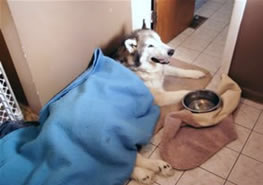 your pet.
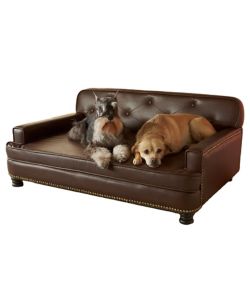
Softer bedding and vet-approved vitamins might also soothe creaky joints. A little compromise is to be expected. If you notice that your dog is having trouble hopping up onto his favorite couch, either teach him to stay down, place a stool nearby to help him hoist himself up or provide a soft pillow for him to lie on. Loading your older dog into the car can also become a problem - particularly if overweight. If he can't jump into the back of a high minivan, or even hop into the back seat of a car, use a strong plank of wood with a nonslip surface as a ramp to help him walk with dignity into his favorite cruising seat. Elevating his food dish to chest-height is an especially good idea with an older dog, since bending only contributes to more pain and neck-strain problems. Do all that you can to ensure that his comfortable daily routine doesn't change too much. Malamutes LIVE for routine. They need consistency. If your dog is a rescue and has not lived with you all his life, this is even more important. Sick, blind and deaf Malamutes present unique problems - especially those living in packs. The pack mentality is very strong in Mals so an older dog may need your protection from younger "upstarts". The pack mentality of these dogs tends to make them victims of younger dogs - but as alpha you cannot allow this. You must instill by your behavior a respect for the oldster so the other pack members do not pick on him. If a dog is ill, separate him from the others by using a crate or baby gates for his own protection. Sometimes the pack will even alert you to a medical problem you didn't know existed because of a constant "picking on" the oldster. An ill Malamute is in danger of being attacked by the pack, so you must protect him. That is why blind and deaf dogs present such a challenge. In one or two dog homes they will find their way and be fine. We used to use the porch light as a signal to come in at night for our deaf dog (and hand signals for sit, stay, etc.). A blind dog needs your voice to orient himself. All dogs will use their sense of smell to make up for loss in vision and hearing and can lead full lives without one of their senses. A dog experiencing blindness and deafness is at high risk to become aggressive out of fear, so make his life as stable and predictable as possible.
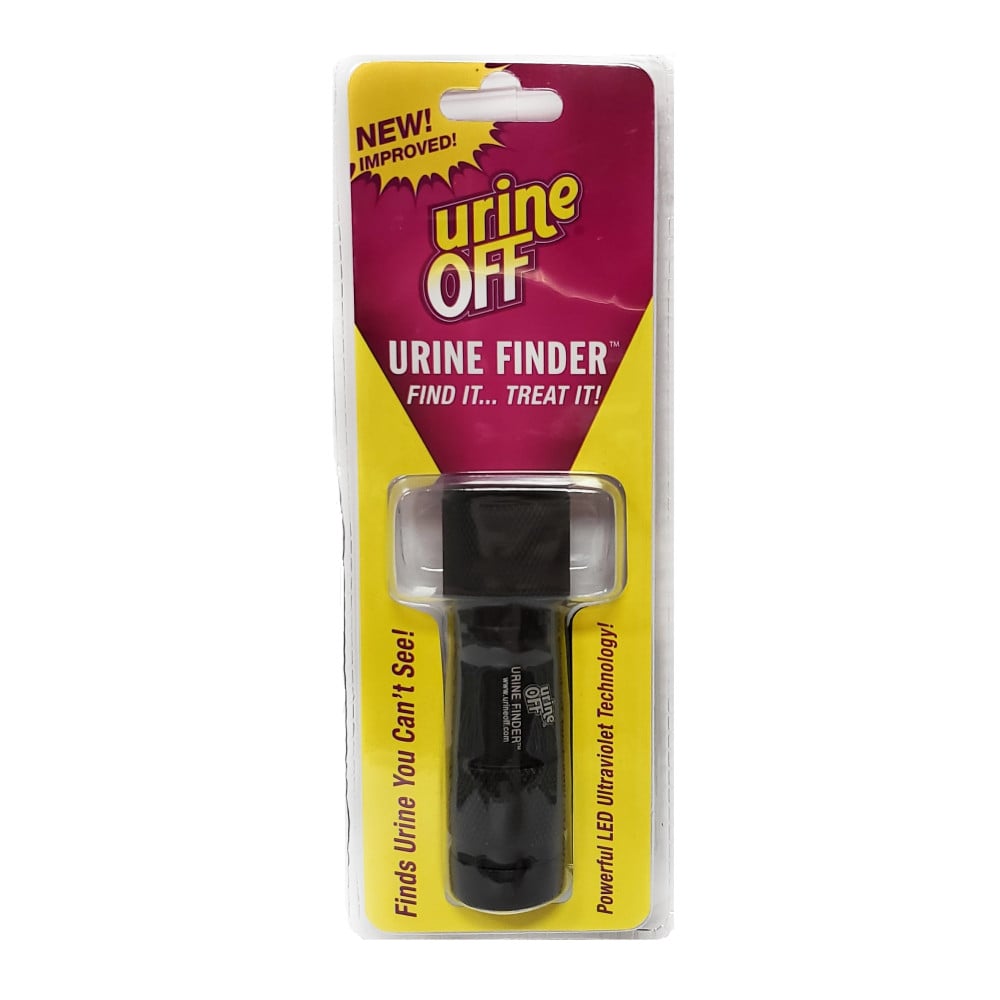
 Old dogs appreciate being brushed and looking nice as much as young dogs (maybe more!). But he may need help getting up on a grooming table or in the tub. Some dogs have difficulty standing for long periods so keep sessions short. Better yet, teach him to lie down on the floor for brushing and a more delicate touch if necessary since there may be unseen lumps and bumps under the thick coat (report anything suspicious to your vet). Some dogs feel very defensive as they age, particularly if part of a "pack". So it's so sometimes it's better if they can be groomed without the other dogs around. We've had to deal with this as Homer became older as the deposed Alpha. For the past year he has been stool and urine incontinent - quite a problem in a normal coat, but he is a wooly. One of the best things we've found is to use an x-pen as a safe haven for an older dog. Homer always loved his crate, but eventually, as he became stool incontinent, being in the crate became quite a problem. He would have trouble getting up in the confined space and it would be quite a mess. Our solution was an x-pen and it's worked well. We put a rubber-backed washable rug on the floor for traction and with blankets over the side, the pen has the feel of a crate giving him security so that he feels safe. We attached a bucket with water to the inside so he has access to water. With the x-pen he is able to be with the other dogs without fear of being attacked. We had to come up with a unique grooming solution for the stool and urine incontinence.
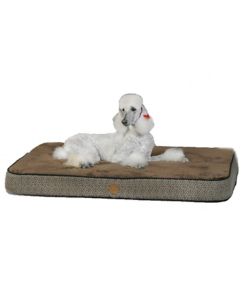
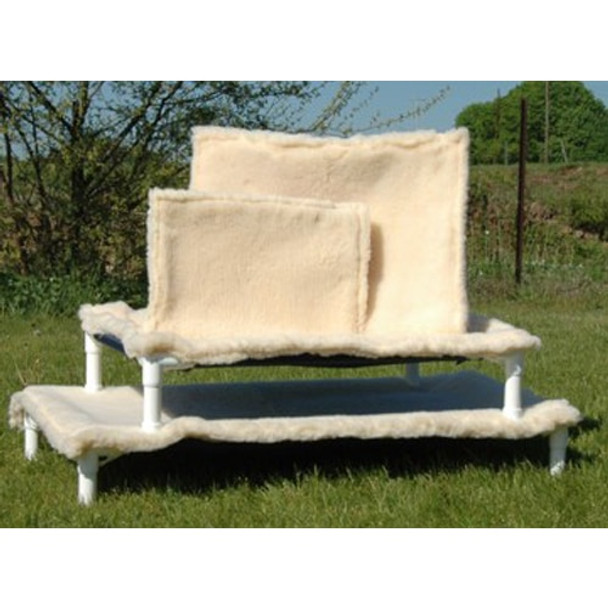
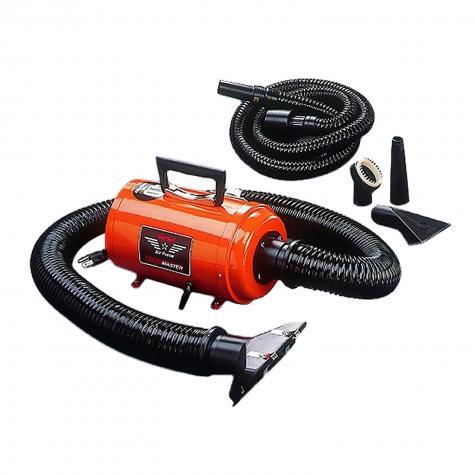
Another solution we've found very helpful - as Shadow is getting older he wanted to move out to the garage. Normally I wouldn't want an old dog in the cold garage, but that's what he wanted and actually it's worked out well.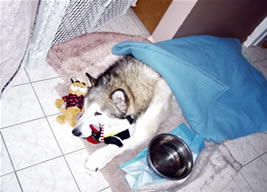 He got his own apartment for the summer with a door to go outside when he needs to and doesn't have to wait for someone to let him out (or worry about the other dogs bothering him). The only worry we had is because we live in Michigan - winters are cold. Solution one was a baby's playpen with a drop side to get him up off the cement floor. Solution two was to put a pet heat mat (we also use it for when we have puppies) in the playpen. It warms just enough to keep him comfortable without getting him too hot. That worked well into late fall until we finally made him come inside. This is the mat we just purchased to replace our old one that finally gave out after 10 years. I've noticed he does seem to get around better when he's been laying on it - I think it feels good on arthritic joints!
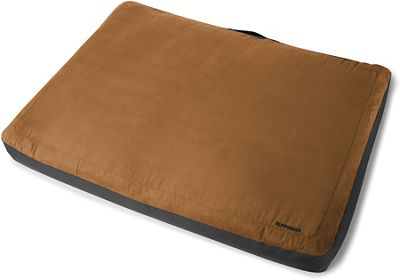
As for Hoover, he liked his comfort! He has took up residence in our entryway on a soft orthopedic bed which is easy to clean and he's nearby when I'm working. Hoover is an easy keeper in that he doesn't ask for much except his water and a squeaky toy now and then. The blanket keeps him warm as old dogs often have weak circulation. Visit a site I built just for Hoover that goes into more detail about old dogs that lack mobility - dogswithdisabilities.com
Don't assume bad breath is from aging. It may be a sign of illnesses such as liver disease, chronic indigestion or stomach ulcers. Chronic halitosis can also be caused by periodontal disease, which can, itself, lead to other health problems, including heart, lung and kidney disease. Keep up with your dog's dental and gum-care routine and report consistent or recurring breath problems to your vet. Many older dogs no longer chew rawhides or bones like they once did and as such, plaque builds up faster on the teeth so it may extend his life to get him some dental type treats if he'll eat them. As always, check your dog's ears, eyes, nose, coat and full body, keeping alert for any changes that may signal illness and most of all keep the weight down!Should you get a puppy before your old dog passes away? It depends. I feel most old dogs would prefer to enjoy your undivided attention in his last months and not have to share with a young puppy (who will demand much of your time). Old dogs usually prefer quiet, sedate and secure surroundings. A youngster can bully and want to play rough with the old dog, possibly causing the old dog more stress than is necessary. Usually it's best to wait until the old dog is gone to get a new puppy. Would you want to meet your replacement knowing you couldn't play or compete with puppy cuteness? Consider how would the old dog feel? Under some circumstances, if the dog is not too infirm, a puppy might be just the thing to perk up the oldster, but I feel generally it's not a good idea. Let the old dog enjoy your company in the remaining time he has left and don't make him share it!
Another issue we've dealt with recently is the assumption that old dogs are expensive. They don't have to be! You can care for an old dog quite adequately with standard medications and a willing vet. A vet that tells you your old dog isn't worth making comfortable, isn't a good vet! We know of people who will put down any dog the minute it becomes sick - the Karma they are accumulating and the things they are teaching their children will haunt them one day! An old dog (or even not so young dog) will give so much back to you if you can just muster a little patience and understanding while they deal with incontinence, strokes, paralysis, seizures and other issues. Don't worry, they will tell you when it's their time. You don't have to hurry them along!
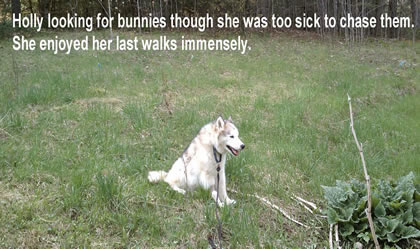
Often I'm asked, how will I know when it's time? Look at their eyes and listen to your inner voice. They will tell you. When we took Holly to the vet because things weren't quite right I had the strongest feeling she was concerned we were there to put her down! We weren't - it hadn't crossed our minds - but I picked up on her feelings somehow and reassured her we'd do it "her way". Later, as she was fading away and seemed in pain we rushed her to the vet hoping to spare her pain - but she left before the vet could prepare the shot. She did it her way in spite of us. They will tell you if you listen just like they always have told you things when you've opened your mind.
The hardest part of dealing with an old or sick Malamute is dealing with veterinarians. Unfortunately, most do not really understand these dogs and their intense pack needs. It is your job to be his advocate - if he is more comfortable being treated at home and you can do it - speak up! If he is "hiding" his illness 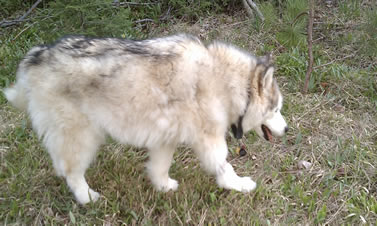 and seems perfectly fine at the vet's office when at home something is "not right" it's your job to insist things be checked out. If his situation is terminal, if she would be happier at home with her pack rather than having a vet take extraordinary measures, speak up and take her home.
Malamutes are notorious for hiding how sick they really are from people that are not their human family. This is a pack thing - the weak get killed - so they are hiding their vulnerability - unfortunately many vets don't realize this and think the dog is in better shape than it is. We've had this happen several times - you must speak up and tell the vet you KNOW your dog is very sick (Malamutes have died being so stalwart rather than let on that they are sick to a stranger) and needs to be checked out. This is particularly true if your malamute is not eating normally or refusing food. If need be, get a second opinion. We once almost lost Shadow because the vet didn't take his being sick seriously enough. He refused to eat (a very strong sign with a Malamute that something is very wrong!) and was vomiting up everything. Because of the slower metabolism he wasn't losing weight very fast so she just gave him some antibiotics and sent him home. Within a couple of days he was almost dead from dehydration - but until he was within hours of dying, he didn't even act sick in the vet's office. Fortunately a second opinion saved his life.
Many Malamutes are finicky about specific foods or where they potty anyway, and when sick become worse if they stay in the clinic - but at home would do just fine. The veterinarians at MSU (a top notch vet school) needed to get a friend's mal to eat after a devastating illness. He refused everything they gave him - canned special foods, home-cooked people food. As his advocate she brought him his favorite - TUNA (succulent mal treat that it is!) and he ate. (During Shadow's illness the only thing HE would eat were Doritos ;-) . The vets at MSU couldn't believe it. As Holly
drifted away, she would only eat french fries. Never underestimate a Malamute - they are very loyal to the pack, and in their depression of
being separated from their pack during illness, sometimes would rather starve. Also, never underestimate a malamutes' refusal to eat (when they've been a poster child for "I'm starving" all their lives) as just a passing phase. A malamute that refuses to eat is very very sick and needs to be checked out by a vet immediately. Some mals are picky eaters all their lives (rare, but happens!), but for the ones that aren't - it's a sure-fire sign something is seriously wrong. A dog that picks at his/her food when they normally inhale it, is dying or seriously ill.
Get her to a vet immediately and if that vet won't take your concerns seriously, get another vet!
One last thing, if your older malamute suddenly becomes anxious at certain times when he never was before, consider that dogs also get altzheimer type symptoms. Confusion, fearfulness, and anxiety are much more common than I feel anyone has realized...it may be a cause of bloat and other problems in older dogs. There's a name for this: Sundowning....and you will make your dog's older years that much more comfortable being aware of this.
Alaskan Malamutes are a generally robust dog so they typically bounce back if their illness is taken care of properly and their pack needs are met. So always remember, you MUST be your Malamutes' advocate at the veterinarians' office!
Visit our Hoover's Site - Dogs with Disabilities - dedicated to dogs with ongoing special needs.
Walk with an Old Dog
Because you will not be forever,
Hope against time I may,
I paint your picture in my memory,
Eyes blue with age, muzzle gone grey.
Because you walked with me in springtime,
Puppy-clumsy, running free.
As you grew older we grew together.
You became part of me.
Because you shared with me my sorrows,
Not understanding, simply there.
Often spurring me to laughter,
My friend, you know how much I care.
Because the years have slowed your fleetness,
Though your spirit is still strong.
I promise I will take more time now,
So that you can go along.
Because you do not fear the future,
Living on in the now,
I draw strength from your example,
Yet time keeps slipping by somehow.
Because the day will soon be coming
When I will no longer see,
You rise to greet me, but in my memory,
You will always walk with me.
(c) Gayl Jokiel

When I am Old...
I shall wear Turquoise and soft gray sweatshirts...
and a bandana over my silver hair....
and I shall spend my Social Security Checks on
Sweet Wine and My Dogs....
and sit in my house on my well-worn chair
and listen to my dog's breathing.
I will sneak out in the middle of a warm Summer night
and take my dogs for a run, if my old bones will allow...
and when people come to call,
I will smile and nod as I show them my dogs...
and talk of them and about them...
The Ones so Beloved of the Past
and the Ones so Beloved of Today...
I still will work hard cleaning up after them
and mopping and feeding them
and whispering their names in a soft, loving way.
I will wear the gleaming sweat on my throat, like a jewel
and I will be an embarrassment to all...
and my family...
who have not yet found the peace
in being free to have dogs as your Best Friends...
These friends who always wait, at any hour, for your footfall...
and eagerly jump to their feet out of a sound sleep,
to greet you as if you are a God.
With warm eyes full of adoring love and hope that you will stay
and their big, strong necks...
and kiss their dear sweet heads...
and whisper to their very special company...
I look in the Mirror...
and see I am getting old....
this is the kind of woman I am...
and have always been.
Loving dogs is easy,
they are part of me,
accept me for who I am,
my dogs appreciate my presence in their lives..
when I am old this will be important to me...
you will understand when you are old...
if you have dogs to love too.
-Author Unknown